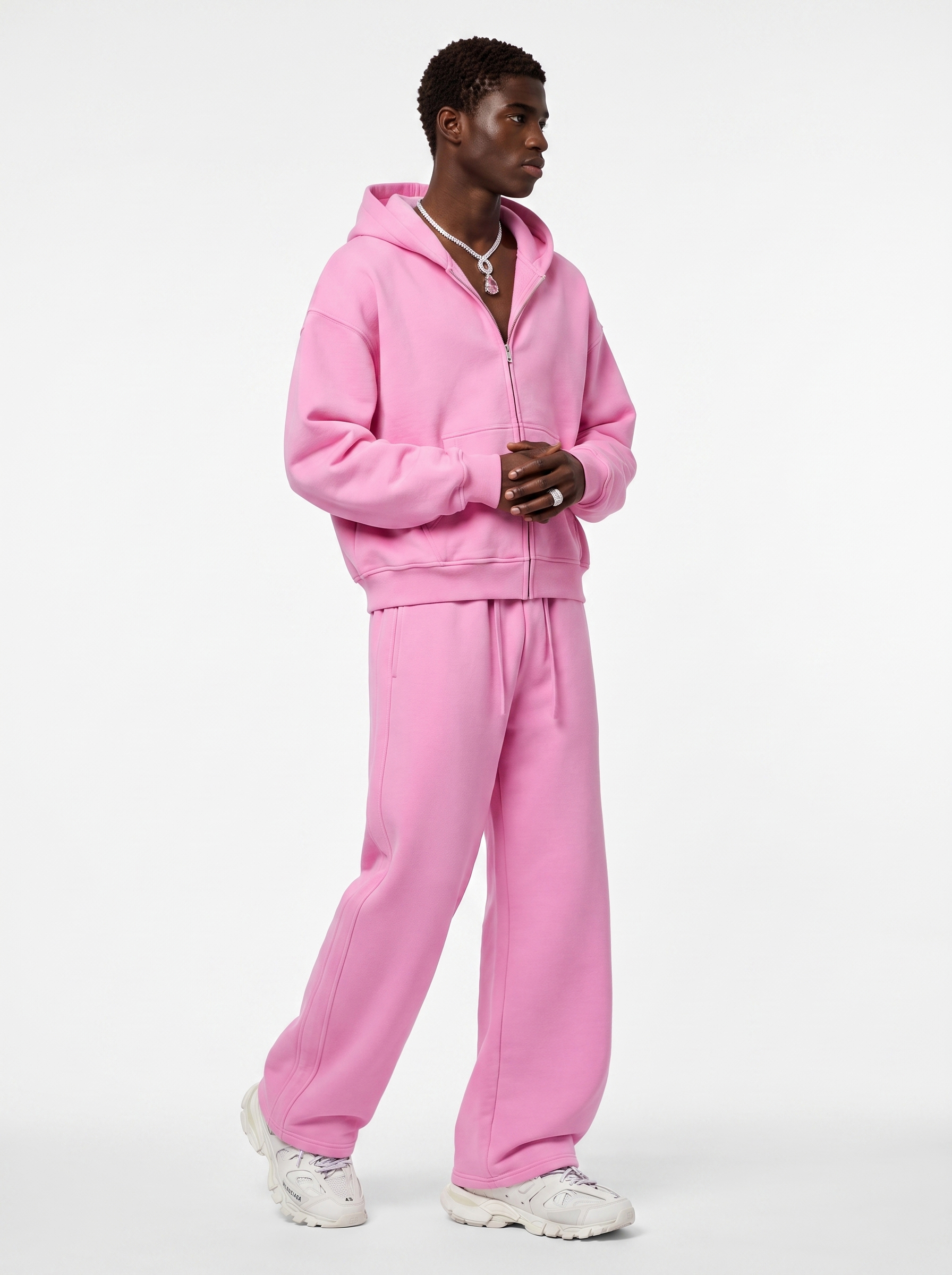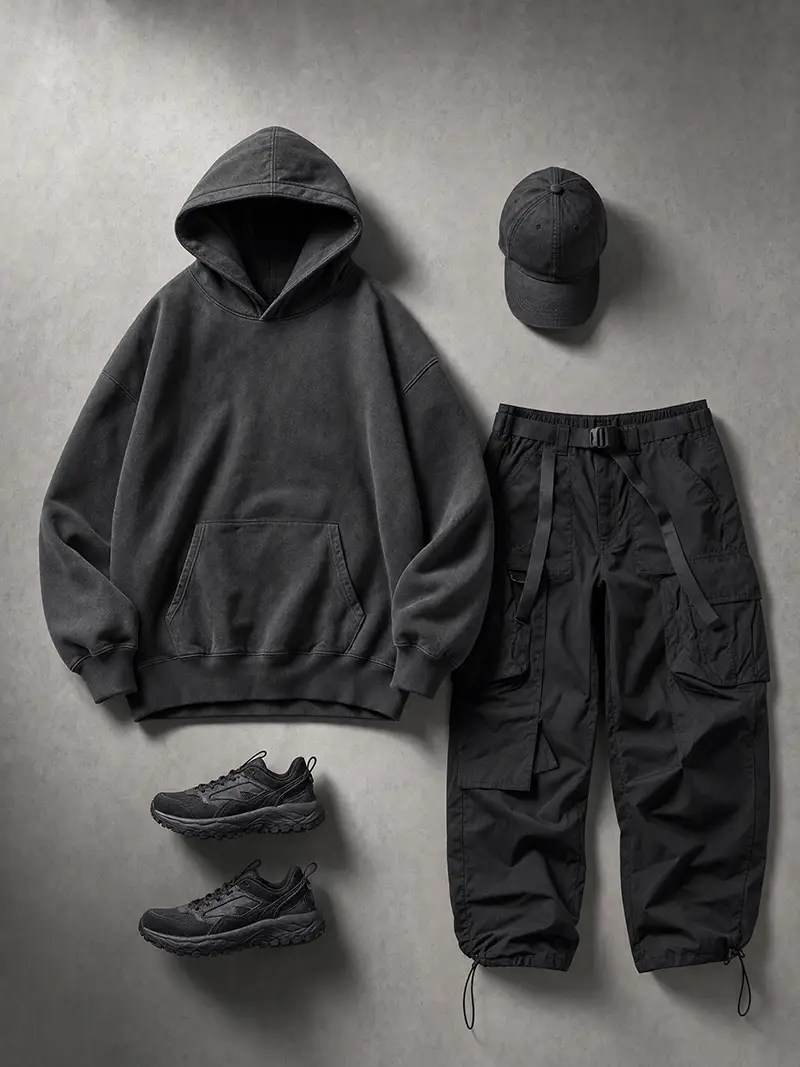
Oversized hoodie fit is not created by making every regular-hoodie measurement larger. It comes from a controlled relationship between chest, shoulder, body length, sleeve, hood, rib, and the fabric’s post-wash drape.
Quick answer: Define the target wearer and base size. Measure the body and garment separately, calculate ease, and diagram every measurement point. Approve the actual fabric before and after the intended wash, then check risk sizes before bulk cutting.
Scope note: The calculations are examples, not universal standards or disclosed Dohyee specifications. A pattern maker must set the production measurements, grade rules, tolerances, and wash allowances.
What Makes an Oversized Hoodie Look Intentional?
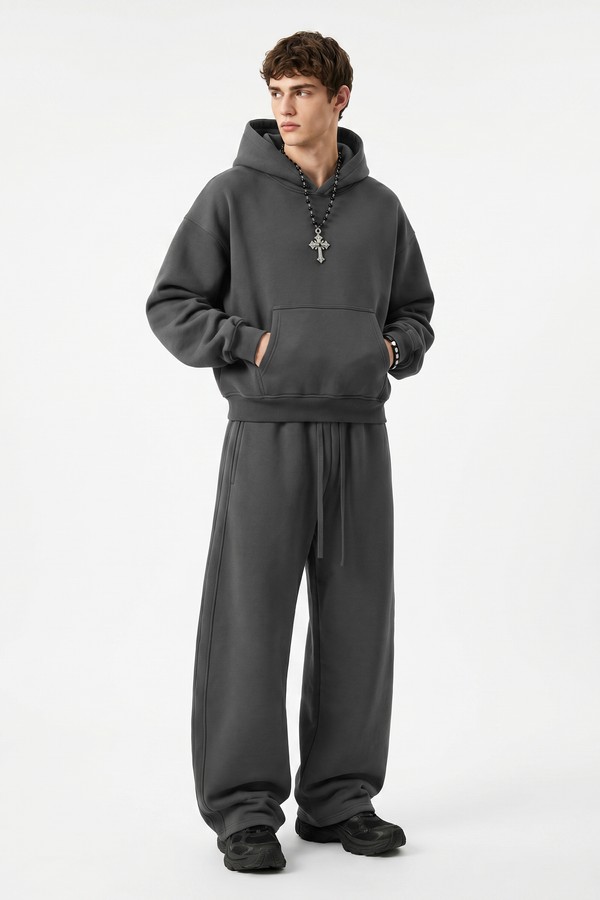
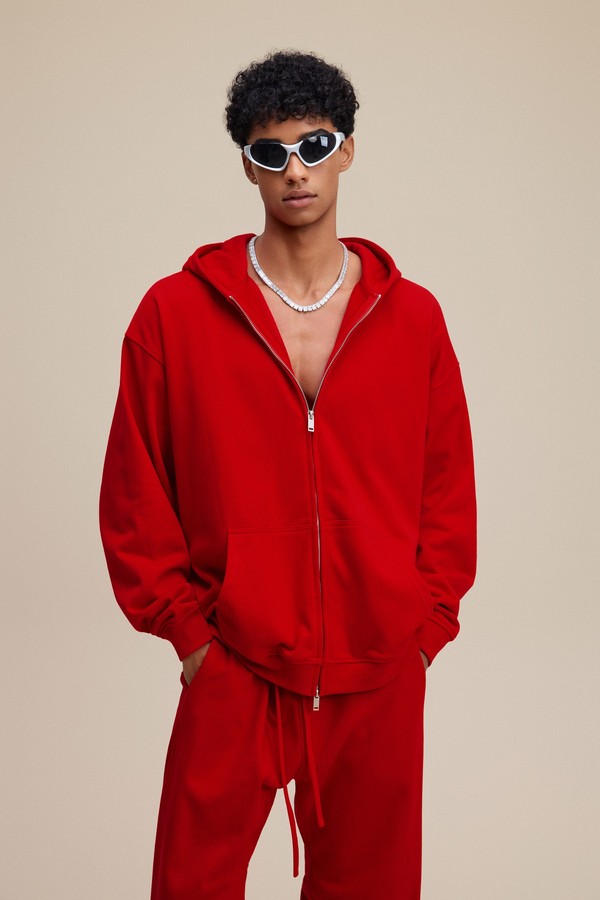
An oversized hoodie should look designed, not three sizes too large. The body can be wide without becoming long; the shoulder can drop without pulling the sleeve over the hand; and the hood can have volume without dragging the neckline backward.
Name the silhouette before discussing centimeters. A cropped boxy pullover, long relaxed zip hoodie, and extreme drop-shoulder hoodie are different products. State the direction in one sentence and annotate front, side, and back references. The sample room cannot grade a mood.
Body Measurements and Garment Measurements Are Not the Same
Body dimensions describe the wearer. Finished garment dimensions describe the product under an agreed measuring method. Their difference includes movement ease, design ease, material thickness, and visual proportion.
ISO 8559-1:2017 describes anthropometric measurements used for size and shape profiles. ISO 8559-2:2025 addresses body dimensions for clothing size designation. Neither supplies a universal oversized hoodie chart.
Example: a 98 cm body chest and 66 cm flat garment half-chest give an estimated 132 cm garment circumference. Total chest ease is:
132 cm garment circumference – 98 cm body chest = 34 cm total ease
That is 34 / 98 x 100 = 34.7% of the body chest. It is a comparison method, not a recommended target. The measuring location, zipper position, flattening method, and seam treatment must stay consistent.
Define These 11 Hoodie Measurements Before Sampling
| Point of measurement | Why it matters | Definition that must be fixed |
|---|---|---|
| 1. Half chest | Controls torso volume and much of the visual oversize | Distance below the armhole and whether measured edge to edge |
| 2. Shoulder width | Sets the drop-shoulder position | Seam to seam across the back, following or straight across |
| 3. Body length | Separates boxy, regular, longline, and cropped fits | High point shoulder to hem, including or excluding rib |
| 4. Armhole depth | Affects mobility, sleeve pitch, and underarm bulk | Straight, diagonal, or along the seam |
| 5. Sleeve length | Controls wrist position after the shoulder drops | From shoulder seam, center back neck, or another fixed origin |
| 6. Bicep width | Controls upper-sleeve volume and movement | Specified distance below the armhole |
| 7. Cuff opening and height | Stops a wide sleeve from swallowing the hand | Relaxed opening, stretched opening if needed, and finished height |
| 8. Hem width and rib height | Controls whether the body hangs straight or blouses | Relaxed width, rib height, and measurement location |
| 9. Hood height and depth | Controls coverage, volume, and neckline pull | Seam origins, panel construction, and opening method |
| 10. Neck width and front drop | Affects entry, comfort, hood balance, and collar exposure | Seam-line or edge measurement and garment position |
| 11. Pocket size and placement | Changes the visual center of the front body | Width, height, opening, centerline, and distance from hem |
Put a numbered diagram beside this table in the hoodie tech pack. “Sleeve length” is ambiguous when one team starts at the shoulder and another at center back neck.
Choose the Silhouette Before You Choose the Size Chart
Start from shape, not a competitor’s size label. A boxy hoodie relies on width-to-length proportion; a long relaxed hoodie adds both; a cropped version preserves volume while reducing length. A zip-up also needs center-front and open-wear balance.
Measure reference garments and record their condition, fabric, marked size, wearer, and wash history. A worn hoodie may have relaxed, shrunk, or stretched. “Fit like this” becomes useful only after the reference is interpreted.
Balance Chest Width with Hem Width
Chest width creates room; hem width decides where it goes. A similar hem gives a straighter body. A narrower, stronger rib creates a blouson shape. Too tight and the body balloons; too weak and the hem can flare.
Record rib composition, structure, relaxed width, stretch, recovery, height, attachment ratio, and wash behavior. Do not approve the shell and leave “matching rib” open. Dohyee’s fabric options are a starting point for that discussion.
Drop the Shoulder, Then Recheck the Sleeve
A common first-sample error is moving the shoulder outward while retaining the original sleeve. Total reach from center back neck to cuff then becomes too long.
Evaluate shoulder and sleeve together, then check sleeve pitch, armhole, bicep, elbow, and cuff. Photograph front, side, and back. Does the cuff stay at the intended wrist when the wearer reaches, bends an elbow, and uses the pocket?
Body Length Decides Whether Wide Looks Boxy or Simply Big
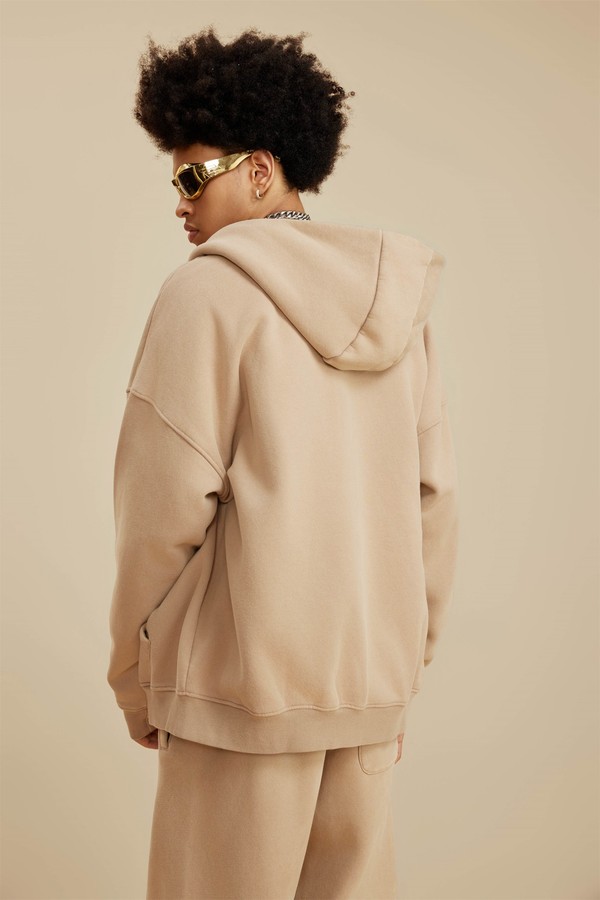
Two hoodies with the same half-chest can look unrelated because their lengths differ. Approve the width-to-length proportion and hem position. Define the high point shoulder and whether length includes rib.
One fit model does not prove a broad unisex range. Inspect edge sizes or a size set: the smallest may become too short, while the largest may gain unwanted length.
Build the Hood Around the Neckline, Not in Isolation
A hood can look good flat and fail on the body. Height, depth, opening, overlap, panels, lining, seam bulk, drawcord route, and neckline attachment alter its balance. Heavy hoods can pull backward; shallow ones can feel restrictive.
Check the hood up and down. For zip hoodies, confirm that both sides meet without forcing the neckline upward. Define eyelets, drawcords, stoppers, and hardware in the custom apparel accessories specification.
Place the Pocket After the Body Proportion Is Approved
A standard pocket copied onto a wider body can look small or sit too high. Set its width, height, opening, angle, center, and hem distance. Test both openings on the wearer.
For a zip-up, check symmetry closed and pocket position open. Approve artwork against the pocket, zipper, and seams; the screen printing vs embroidery guide covers related process constraints.
Fabric Weight Changes the Same Pattern
The same pattern looks different across fabrics. Compact heavyweight fleece may hold shape; lighter French terry may fall closer to the body. Knit, yarn, fiber, finish, wash, and rib change drape even when tape measurements match.
Use the hoodie GSM guide and French terry vs fleece guide, then sample the intended material. A substitute can test construction, but not final drape, bulk, rib, or wash response.
Grade the Fit Instead of Scaling Every Point Equally
Grading moves a base pattern through the range; it does not add the same amount everywhere. Each point can follow a different progression, and some may remain constant to preserve the silhouette.
This illustrative three-size example shows the logic. It is not a production recommendation:
| Finished measurement | Size S | Size M base | Size L | Example rule |
|---|---|---|---|---|
| Half chest | 64 cm | 66 cm | 68 cm | 2 cm per size on the half measure |
| Body length | 67 cm | 68 cm | 69 cm | 1 cm per size |
| Shoulder width | 61 cm | 62.5 cm | 64 cm | 1.5 cm per size |
| Sleeve length from shoulder | 57.5 cm | 58 cm | 58.5 cm | 0.5 cm per size |
| Cuff opening, relaxed | 9.5 cm | 10 cm | 10.5 cm | 0.5 cm per size |
Here M to L adds 4 cm in estimated chest circumference but 1 cm in length. The shoulder gains more than the sleeve because its origin moves outward. Actual rules require pattern and fit approval.
Do Not Confuse Grade Rules with Measurement Tolerances
A grade rule is the planned difference between sizes. A tolerance is permitted variation around one specification. A 66 cm M and 68 cm L have a 2 cm grade increment; that does not mean either may vary by 2 cm.
Set tolerances by point and method. They must reflect material, construction, process capability, and buyer requirements. Too tight creates disputes; too loose can blur adjacent sizes.
Approve the Post-Wash Fit, Not Only the Fresh Sample
Knit hoodies can change after relaxation, washing, drying, dyeing, or finishing. Measure under controlled conditions. ISO 3759:2011 covers preparation, marking, and measurement, while ISO 5077:2007 covers dimensional change after washing and drying.
Example: if post-wash length must be 68.0 cm and validated loss is 2.0%, the starting estimate is:
68.0 / (1 – 0.02) = 69.39 cm
This is not a final pattern correction. Test the actual sample because sewing, rib, pressing, and treatment interact. Record change by direction and measurement point. The garment washing guide explains the finish variables.
Run a Fit Session That Produces Decisions
Use the same fit model or documented body profile across revisions. Verify measurements, then ask the wearer to stand, sit, reach, bend, use the pocket and hood, and operate the zipper.
Write comments as actions: “reduce body length 1.5 cm from HPS” or “move pocket down 2 cm.” Avoid “more oversized.” Update the tech pack and revision number.
Photograph front, back, sides, hood up and down, movement, and each issue. Keep the approved sample, measurement report, wash report, and comments together so fit connects to the hoodie manufacturing process.
Check Edge Sizes Before Bulk Cutting
A base-size sample does not prove the range. Review the smallest and largest risk sizes. Recheck hood, pocket, cuff, body proportion, and shoulder-sleeve balance.
A wide unisex range may need separate blocks, a grade break, or clearer body guidance. A size label cannot solve a pattern problem.
Turn the Approved Spec into a Useful Online Size Chart
Give customers comparable garment measurements and instructions. State units, half chest or circumference, whether length includes rib, and the sleeve origin. Add accurate model body measurements and size worn.
Do not call deliberate extra volume “true to size.” Describe the boxy body, drop shoulder, length, sleeve, and unisex intent. Align the chart and care guidance with the approved garment condition.
Oversized Hoodie Fit Approval Checklist
- Target wearer, body profile, base size, and silhouette are named.
- Body measurements and finished garment measurements are stored separately.
- Every point of measurement has a diagram, origin, path, and garment condition.
- Chest, hem, shoulder, sleeve, cuff, hood, neck, and pocket work as one system.
- Fit is approved in intended materials and finish.
- Pre-wash and post-wash measurements are recorded with the test conditions.
- Grade rules and tolerances are documented separately.
- Risk sizes are checked before pattern release.
- Fit photos, comments, sample status, and revision history are traceable.
- E-commerce size-chart wording matches the approved measuring method.
Oversized Hoodie Fit FAQ
How much bigger should an oversized hoodie be?
There is no universal number. Set the body profile, calculate ease, and balance width with length, shoulder, sleeve, hood, and fabric.
What is chest ease in a hoodie?
It is the difference between garment and wearer chest circumferences. Label both and document the garment measuring method.
Should I size up to make a hoodie oversized?
Not for development. Sizing up also adds length and moves graded points. Build an oversized block with deliberate width, length, shoulder, and sleeve relationships.
How do I measure an oversized hoodie sleeve?
Choose one diagrammed origin, such as shoulder seam or center back neck. A dropped shoulder changes apparent reach.
Why does an oversized hoodie feel too long in the arms?
The shoulder may move outward while the sleeve stays unchanged. Review total reach, armhole, pitch, bicep, cuff, and movement together.
Does heavyweight fabric make a hoodie look more oversized?
It can hold volume away from the body, while softer fabric may drape closer. GSM alone cannot predict the result.
What sizes should be sampled before bulk production?
Approve the base, then check edge sizes based on the grade plan. A size set helps with broad, unisex, or strong drop-shoulder ranges.
Should the size chart use body or garment measurements?
Either works when labeled. Garment measurements help comparison with an owned hoodie. Never mix body and garment values in one row.
Primary References
- ISO 8559-1:2017 – anthropometric definitions and body-measurement principles for clothing development.
- ISO 8559-2:2025 – primary and secondary body dimensions for clothing size designation.
- CottonWorks: Garment Construction – pattern engineering, basic blocks, markers, cutting, and garment components.
- ISO 3759:2011 – preparation, marking, and measurement for dimensional-change tests.
- ISO 5077:2007 – determination of dimensional change after washing and drying.
Develop an Oversized Hoodie Fit with Dohyee
Prepare the target customer, reference garments, body profile, size range, intended silhouette, quantity, fabric and rib direction, wash, artwork, labels, and delivery requirement. Dohyee can review the brief through its OEM streetwear manufacturing service, develop the pattern and sample, and connect the approved fit to bulk production controls.
For supplier scope, sampling questions, and order preparation, read the custom hoodie manufacturer guide. Internal contact: Send the style brief through the Dohyee contact page.