French terry vs fleece is primarily a comparison of reverse-side structure and finishing, not a contest between a low-quality and high-quality fabric. Both can produce a premium hoodie when the yarn, knit density, finished weight, dyeing, finishing, pattern, and sewing are controlled.
Quick answer: Choose French terry when you want an un-napped loop or float back, a drier hand, less interior loft, and a versatile layering piece. Choose sweatshirt fleece when you want a brushed or napped reverse, a softer first touch, more loft, and a cold-weather direction. Do not approve either material from a GSM number or fiber label alone.
Scope note: In this guide, “fleece” means knitted sweatshirt fleece. It does not mean polar fleece, sherpa, or bonded outerwear fleece.

What Is the Structural Difference Between French Terry and Fleece?
Both fabrics normally have a jersey-like technical face and additional yarn activity on the reverse. The visible difference is created after knitting. CottonWorks describes French terry as an un-napped two-end fleece with float loops on the technical back. Brushing or napping those reverse-side yarns creates the fleecy surface associated with sweatshirt fleece. In three-end fleece, separate face, tie-in, and pile yarns allow more control over the face and pile.
| Comparison point | French terry | Sweatshirt fleece |
|---|---|---|
| Reverse | Loops or floats remain visible | Reverse yarns are brushed or napped |
| First hand feel | Drier and less lofty | Softer and loftier |
| Typical direction | Layering, transitional weather, washed streetwear | Cold-weather hoodies and soft interior programs |
| Inspection focus | Loop uniformity, pulls, skew, shrinkage | Nap evenness, loose fiber, pilling, matting |
| Important limitation | “Terry” does not define composition or GSM | “Fleece” does not prove warmth or durability |
The construction explanation above follows the CottonWorks single and double knits reference. Ask a supplier to identify the fabric as two-end or three-end, napped or un-napped, and to show both sides of the approved swatch.
Use These 9 Checks Before Choosing Hoodie Fabric
- End use: Define climate, indoor or outdoor use, layering, retail season, and expected wash frequency.
- Finished composition: Record each fiber percentage, not “cotton blend.”
- Knit construction: State two-end or three-end and identify the face, tie-in, and pile direction where applicable.
- Finished GSM: Measure the conditioned, finished fabric and set an agreed tolerance.
- Face and reverse: Approve face smoothness, loop or nap appearance, shade, and hand with a sealed swatch.
- Dimensional stability: Test length, width, twist, and rib-to-body compatibility after the agreed wash cycle.
- Surface durability: Evaluate pilling, fuzzing, matting, abrasion, and loose fiber against the intended use.
- Process compatibility: Confirm printing, embroidery, garment dyeing, washing, and drying on the actual fabric.
- Bulk controls: Define roll, lot, shade, weight, width, defect, and finished-garment approval rules before cutting.
Two-End and Three-End Fleece Are Not Interchangeable
Two-end construction uses a face yarn and a backing yarn system. It can produce French terry when the back remains un-napped or fleece when the back is napped. Three-end fleece adds a tie-in yarn between the face and pile systems. This lets a mill engineer a cleaner face and fuller reverse, but the words “three-end” are not a complete quality specification.
Yarn count, twist, stitch length, machine gauge, density, finishing, and usable width still change the result. A tightly controlled two-end fabric can outperform a poorly finished three-end fabric for a particular product. Keep the approved construction code and physical swatch in the hoodie tech pack rather than writing only “premium fleece.”
Why GSM Alone Does Not Tell You Which Hoodie Is Warmer
GSM is fabric mass per unit area. It does not directly measure thickness, air trapped by the pile, air permeability, moisture behavior, or the thermal performance of a finished garment. A 350 GSM French terry and a 350 GSM fleece have the same nominal area mass, yet their reverse surfaces and loft can feel different.
For an illustrative calculation, if a marker uses 1.60 square metres of 350 GSM fabric, the theoretical shell mass is 1.60 × 350 = 560 g before cutting loss, rib, thread, zipper, labels, and processing. The equation helps compare material consumption; it does not predict warmth. ASTM D3776/D3776M-20(2025) covers fabric mass per unit area. Where a thermal claim matters, agree a laboratory method; ISO 5085-1:1989 is one method for low-thermal-resistance textile materials.
Use the best GSM for hoodies guide to connect finished weight with silhouette, hood structure, rib, and production risk instead of treating one number as a quality grade.
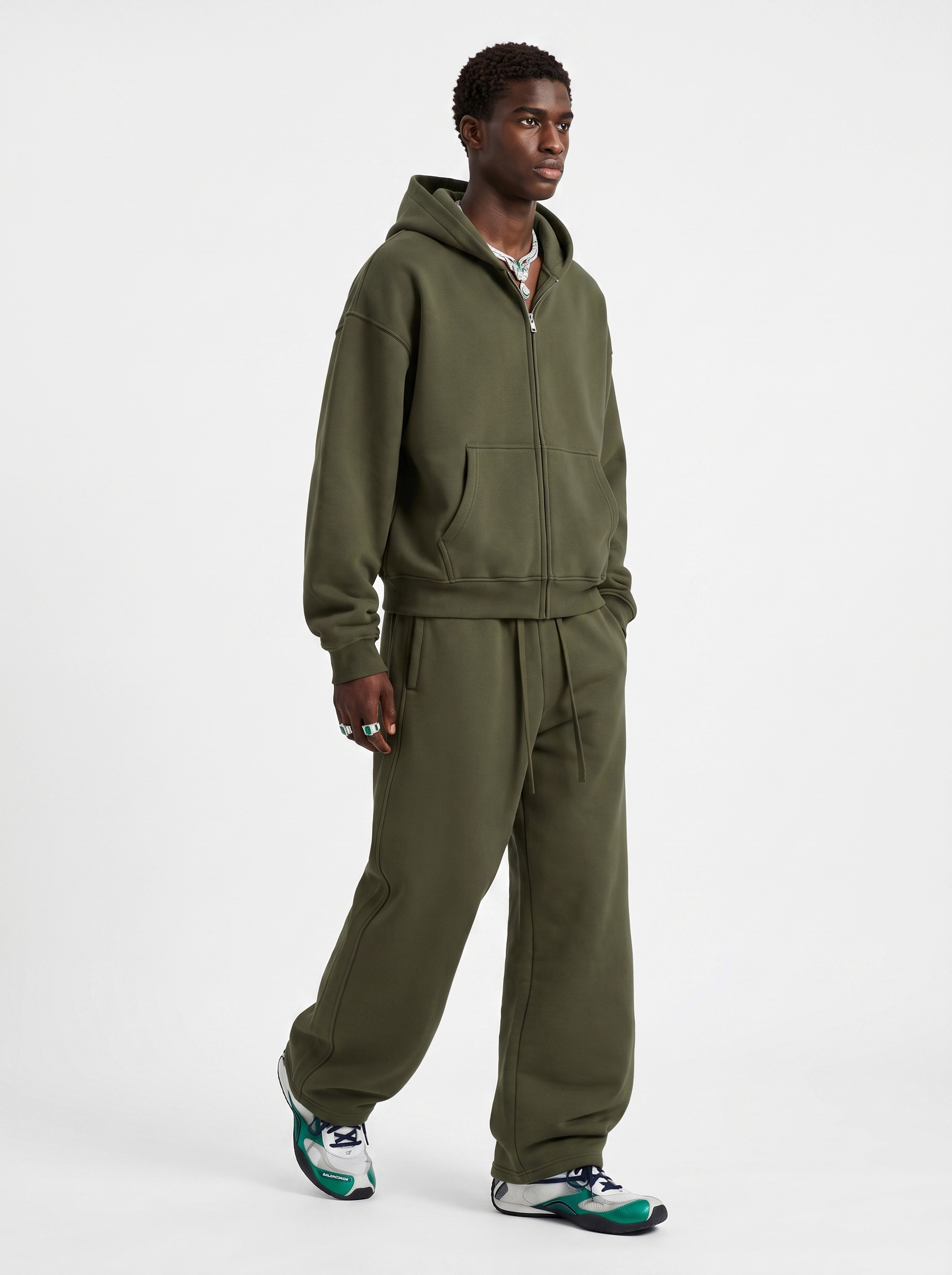
Compare Composition, Hand Feel, Drape, and Recovery Together
Cotton-rich fabrics can support a dry, substantial hand and certain dye or wash effects. Polyester in a blend can change strength, drying behavior, dimensional response, pilling behavior, and how the reverse is raised. Elastane may be added in rib or selected fabrics for recovery, but its presence does not automatically solve cuff or hem growth.
Evaluate the actual finished swatch, not a fiber stereotype. Bend it, compress it, stretch it across and along the courses, compare recovery, and inspect the face under angled light. Then sew a hood, pocket, cuff, and hem. The fabric that feels impressive as a loose swatch may become bulky at seam intersections or collapse at the hood edge.
| Product direction | Useful starting direction | What must be sampled |
|---|---|---|
| Transitional pullover | French terry, moderate loft | Layering comfort and loop snagging |
| Winter boxy hoodie | Fleece, controlled nap | Hood stand, seam bulk, pilling |
| Vintage washed style | French terry or tested fleece | Shade, hand, shrinkage, reverse appearance |
| Large front graphic | Smooth, stable face | Print cure, distortion, wash result |
| Dense embroidery | Stable face with suitable backing | Puckering, hoop marks, reverse comfort |
Control Shrinkage, Twist, and Rib Balance After Washing
Knitted fabric can change because of fiber behavior, yarn and knit construction, wet processing, finishing, garment making, and care. CottonWorks gives this broader cause-and-effect context in its shrinkage and skewing guide.
Use one documented wash and dry procedure for approval and bulk comparison. ISO 6330:2021 specifies domestic washing and drying procedures for textile testing, while ISO 5077:2007 addresses determination of dimensional change.
The calculation is: dimensional change (%) = (after − before) ÷ before × 100. If body length changes from 70.0 cm to 68.6 cm, the result is (68.6 − 70.0) ÷ 70.0 × 100 = −2.0%. That is an example, not an acceptance limit. The brand and manufacturer must agree the method, number of cycles, conditioning, measurement points, and limits before production.
Test body and rib together. A stable body with an over-shrinking waistband can pull the hem inward; a weak-recovery rib can flare even when body dimensions pass.
Inspect Pilling and Nap Instead of Assuming Fleece Is Better or Worse
Pills form through fiber movement and entanglement at the surface. Fiber type, length, yarn structure, abrasion, raising, and finishing all influence the result. On fleece, also inspect nap height and density, patchiness, matting, shedding, and the appearance after laundering. On French terry, check pulled loops and reverse uniformity.
ISO 12945-2:2020 specifies a modified Martindale method for evaluating pilling, fuzzing, and matting. A report should identify the method, test stage, cycles, rating system, and specimen condition. A bare statement such as “anti-pilling” is not enough for comparison.

Match the Fabric Face to Printing, Embroidery, and Washing
Printers need a sufficiently smooth and stable face, predictable absorbency, and a curing route the fabric can tolerate. Embroidery needs enough stability for stitch density, backing, and hoop pressure. Neither French terry nor fleece guarantees decoration performance; the face yarn and finishing are decisive.
Run strike-offs on production-representative fabric and wash the decorated sample. Check edge definition, color, hand, cracking, dye migration where relevant, puckering, and dimensional change. The screen printing vs embroidery guide provides a separate decoration decision matrix.
Garment dyeing, pigment dyeing, enzyme treatment, spray effects, and softening can alter shade, face character, nap, shrinkage, and seam appearance. Lock the process sequence with the mill and laundry. Dohyee’s garment washing techniques guide explains how to approve the finish without treating a reference photo as a measurable standard.

Compare Cost by Finished Garment, Not Fabric Price Alone
Total material cost depends on price per kilogram, finished GSM, usable width, marker efficiency, cutting loss, shrinkage allowance, rib and trim consumption, dyeing, napping, washing, testing, and defect replacement. Brushing adds a process, but that does not prove every fleece will cost more than every French terry.
For a transparent planning example, 1.65 square metres of 360 GSM fabric equals 0.594 kg of theoretical fabric mass. Adding a hypothetical 6% planning allowance gives 0.630 kg. Replace both assumptions with the factory’s marker and actual finished width before costing. Ask the custom hoodie manufacturer to quote the same approved specification so alternatives can be compared line by line.
Put These Fabric Fields in the Purchase Specification
- Supplier and fabric code, mill, country of origin where required, and approved revision
- Fiber composition and test basis
- Two-end or three-end construction; napped or un-napped reverse
- Finished GSM, usable width, color, dye method, and agreed tolerances
- Face and reverse photographs plus a signed physical swatch
- Hand-feel reference, stretch and recovery requirement where relevant
- Wash and dry method, dimensional-change limits, twist, and appearance criteria
- Pilling, fuzzing, matting, colorfastness, and other market-specific tests
- Decoration and garment-wash sequence
- Lot, shade-band, roll inspection, substitution, and change-approval rules
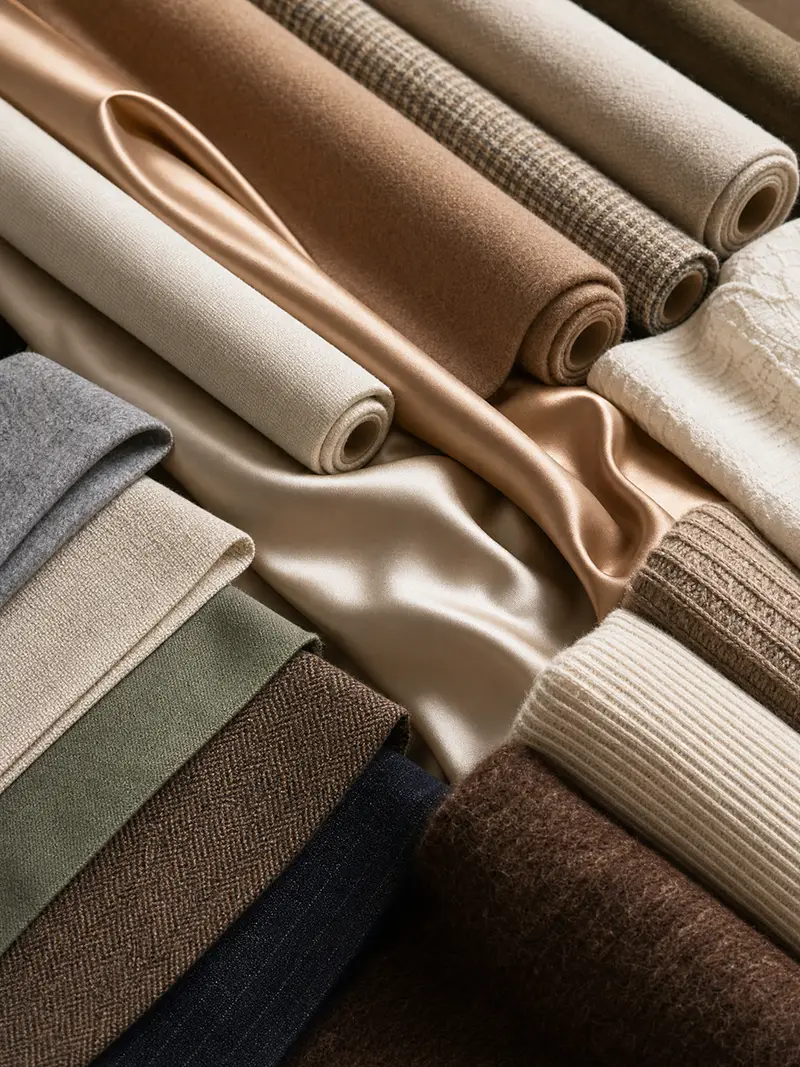
Dohyee’s custom apparel fabric options can be used to discuss jersey, French terry, fleece, twill, denim, nylon, waffle, mesh, and other directions. A photograph can shortlist a fabric, but bulk approval should use a coded swatch and measurable specification.
Sample and Approve the Fabric in a Controlled Sequence
- Confirm use case, composition, construction, GSM, color, and finish.
- Approve a coded handloom or lab swatch with face and reverse identified.
- Test the fabric and record its pre-wash condition.
- Make a prototype using the intended rib, thread, trims, and decoration.
- Wash or finish the complete garment using the planned production route.
- Review fit, measurements, shade, hand, surface, seams, hood, pocket, and rib.
- Approve a pre-production sample and sealed reference.
- Verify bulk lots before cutting, then inspect finished garments against the same references.
A streetwear manufacturer evaluation should therefore ask who controls knitting, dyeing, napping, garment washing, testing, and lot traceability, not only whether the supplier can source “heavy fleece.”
French Terry vs Fleece FAQ
Is French terry warmer than fleece?
Not as a universal rule. Sweatshirt fleece usually has a napped reverse and more loft, but actual warmth also depends on thickness, density, fiber, air permeability, garment design, and layering. Test thermal resistance if you need a measurable claim.
Is French terry the same as unbrushed fleece?
In common industry usage, French terry is technically an un-napped fleece construction. The reverse floats or loops remain visible instead of being brushed into a pile.
Which fabric is better for heavyweight streetwear hoodies?
Either can work. French terry supports a dry, structured, transitional direction; fleece supports a soft, lofty cold-weather direction. Fit, finished GSM, density, hood construction, rib, and wash must be sampled together.
Does a higher GSM mean better hoodie quality?
No. GSM measures area mass. It does not grade yarn quality, knit stability, pilling, shrinkage, colorfastness, sewing, or fit.
Which fabric is better for screen printing?
The fabric with the smoother, more stable, tested face is the better candidate. Run a production-representative strike-off and laundering test rather than selecting by the reverse-side fabric name.
Does fleece always pill?
No, but a raised surface needs appropriate evaluation. Fiber, yarn, raising, finishing, abrasion, and care all affect pilling, fuzzing, and matting.
Should the rib use the same composition and GSM as the body?
Not necessarily. Rib is selected for stretch, recovery, hand, shade, and dimensional compatibility. Test it sewn to the body after the intended wash and dry procedure.
What should a brand send for an accurate fabric quotation?
Send the target product, quantity by color and size, reference or coded swatch, composition, construction, finished GSM, color process, wash, decoration, testing, delivery market, and timeline. Mark uncertain items as open for development.
Primary References
- CottonWorks: Single & Double Knits — French terry, two-end fleece, and three-end fleece construction.
- CottonWorks: Shrinkage & Skewing — factors that influence knitted-fabric dimensional change.
- ASTM D3776/D3776M-20(2025) — mass per unit area of fabric.
- ISO 6330:2021 and ISO 5077:2007 — washing, drying, and dimensional-change testing.
- ISO 12945-2:2020 — modified Martindale evaluation of pilling, fuzzing, and matting.
Develop the Right Hoodie Fabric with Dohyee
Prepare the use case, target fit, quantity, composition, construction, finished GSM, color, wash, decoration, tests, destination, and delivery window. Dohyee can review the brief through its OEM streetwear manufacturing service and develop a sample before bulk production.
Internal contact: Submit the project through the Dohyee contact page.