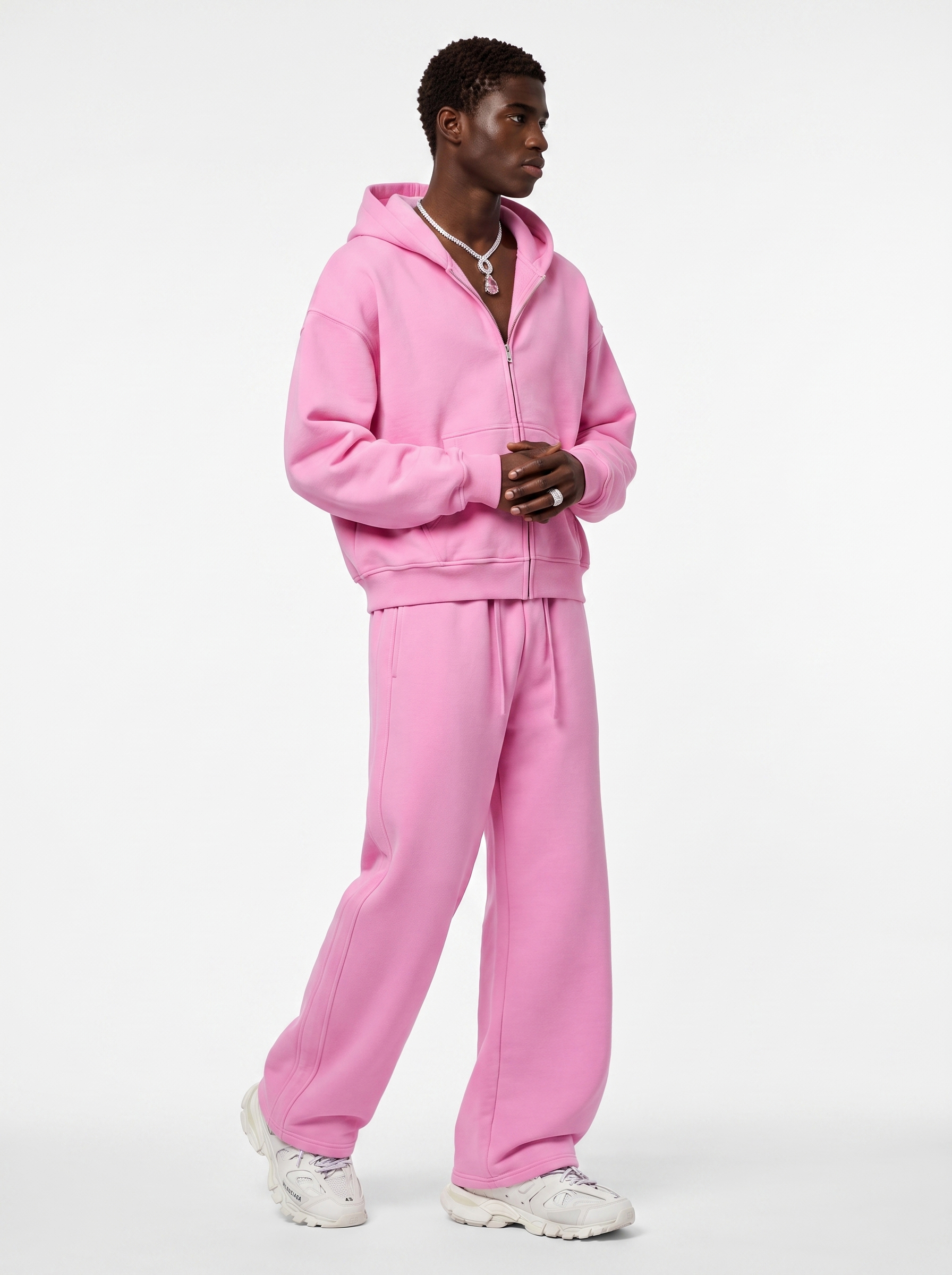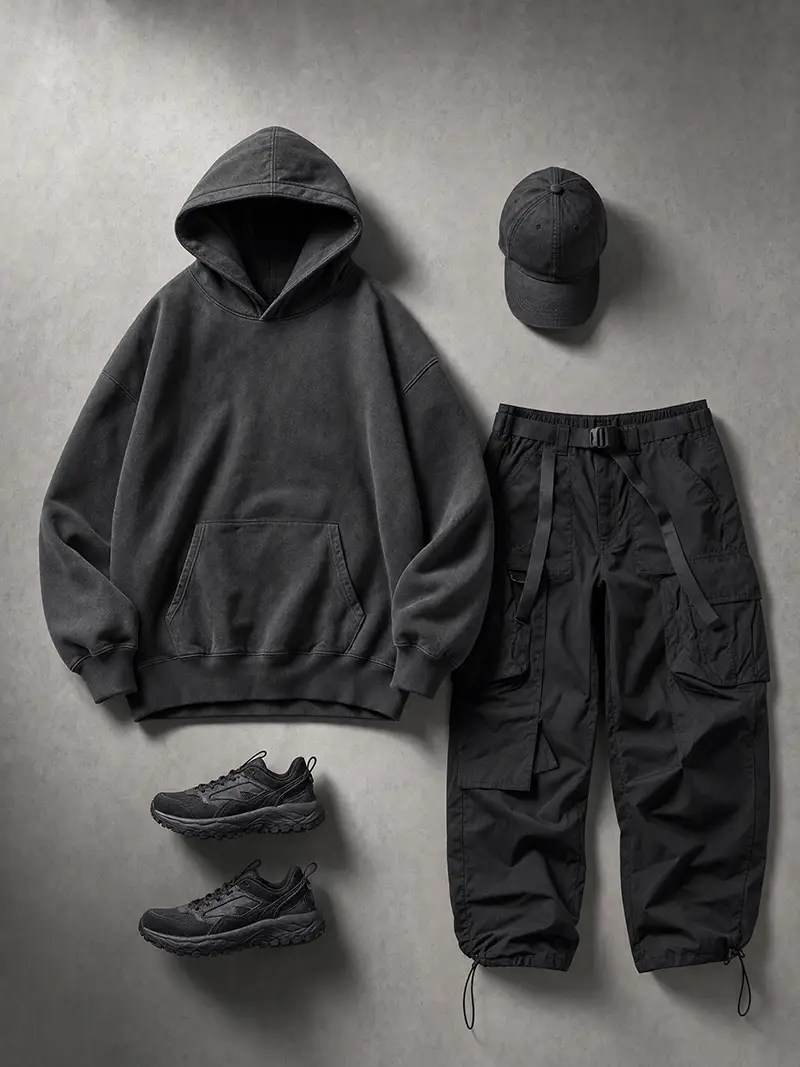
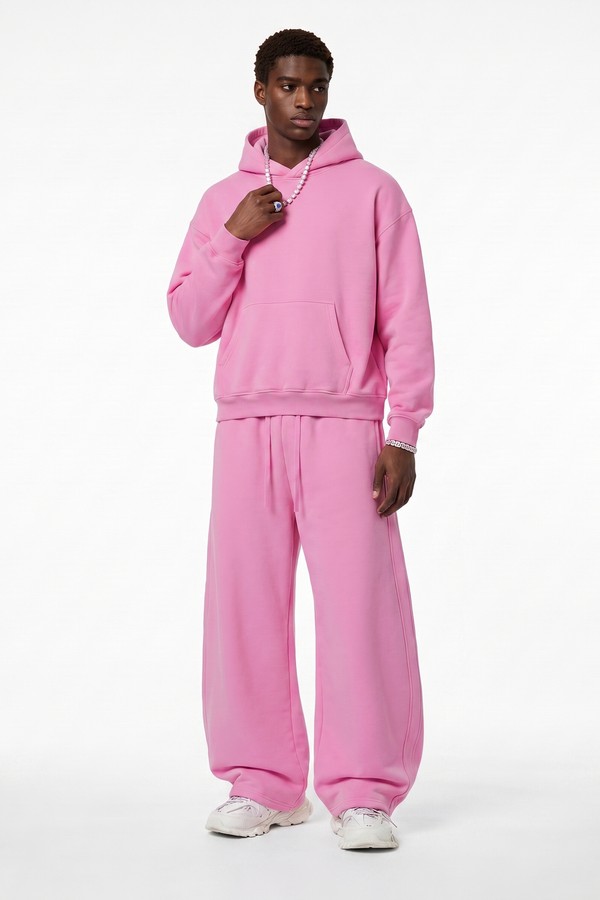
The best GSM for hoodies is not one fixed number. As planning ranges, 280-320 GSM supports easy layering, 330-380 GSM provides a substantial hand, 400-450 GSM suits structured heavyweight styles, and 500 GSM or more is a specialist choice. Construction, fiber, brushing, fit, washing, and decoration still matter.
Quick answer: Start with the customer, climate, silhouette, and hand feel. Compare finished swatches at the same GSM, make a complete hoodie, and test post-wash measurements. State whether GSM applies before or after dyeing, brushing, compacting, and washing, then agree on a method and tolerance.
These GSM bands are sourcing starting points, not universal quality grades. Verify performance on the selected fabric and garment.
What Does GSM Mean for a Hoodie?
GSM means grams per square meter. It reports the mass of a fabric area, not the weight of a finished hoodie. A 400 GSM fabric sample measuring exactly one square meter has a mass of 400 grams under the stated conditioning and test conditions. It does not automatically tell you thickness, warmth, softness, fiber quality, durability, or final garment weight.
The basic calculation is:
GSM = specimen mass in grams / specimen area in square meters
For example, a precisely cut 100 cm2 specimen has an area of 0.01 m2. If it weighs 4.0 grams, the calculated mass is 400 GSM. If it weighs 3.5 grams, the result is 350 GSM. In controlled testing, the specimen, balance, conditioning, cutting accuracy, selvage treatment, and sampling plan all matter.
ASTM D3776/D3776M covers mass-per-unit-area testing for most fabrics and includes different options for full pieces, full-width samples, small swatches, and narrow fabrics. A small swatch can describe that specimen without proving that every roll in a shipment has the same mass.
Best GSM for Hoodies by Product Direction
| Finished fabric GSM | Planning category | Useful starting applications | Main question before approval |
|---|---|---|---|
| 240-280 | Light | Warm-market layers, travel, indoor wear, lighter zip hoodies | Does the fabric recover well enough at cuffs, pocket, and zipper? |
| 280-320 | Midweight | Everyday hoodies, transitional seasons, easy layering | Does the sample feel intentional rather than thin for the retail position? |
| 330-380 | Substantial | Premium basics, relaxed streetwear, year-round core programs | Is the inside looped, lightly brushed, or deeply brushed? |
| 400-450 | Heavyweight | Boxy fits, winter drops, structured premium streetwear | Can the hood, seams, needle setup, and rib balance the extra mass? |
| 480-550+ | Ultra-heavy | Statement pieces and deliberately dense oversized silhouettes | Does extra weight improve the product enough to justify bulk, cost, and freight? |
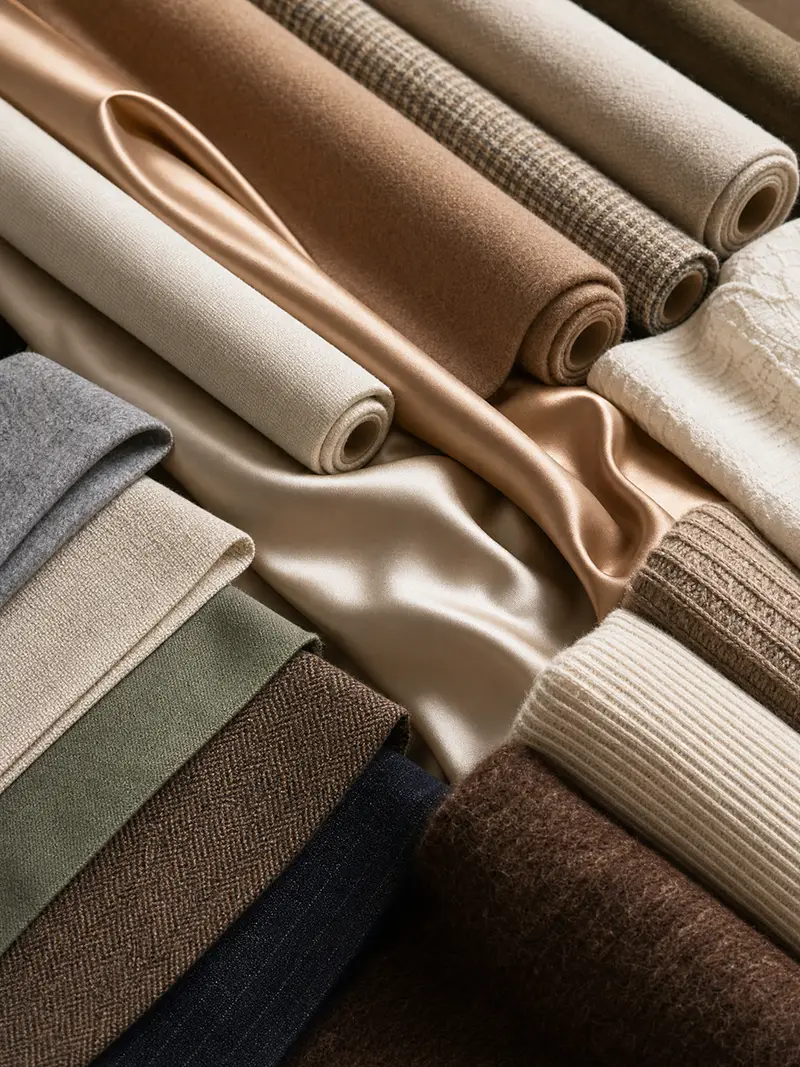
These bands are deliberately overlapping. A dense 360 GSM French terry can look more structured than a lofted 400 GSM fleece, while a brushed fabric may feel warmer without looking sharper. Use the table to request swatches, not to skip sampling. Dohyee’s custom apparel fabric page shows the broader material categories that should be reviewed alongside weight.
280 vs 320 vs 350 vs 400 vs 450 vs 500 GSM
| GSM | Relative fabric mass vs 280 GSM | Likely design direction | Development watchpoint |
|---|---|---|---|
| 280 | 100% | Layerable, mobile, lower-bulk hoodie | Hood collapse, pocket growth, and a weak waistband |
| 320 | 114.3% | Versatile everyday streetwear | Confirm that hand feel matches the intended price tier |
| 350 | 125.0% | Substantial core hoodie without extreme bulk | Compare brushed and loopback versions at equal weight |
| 400 | 142.9% | Structured heavyweight hoodie | Seam thickness, hood pull, shrinkage, and drying behavior |
| 450 | 160.7% | Dense winter or statement streetwear | Machine handling, rib power, decoration distortion, and freight |
| 500 | 178.6% | Ultra-heavy specialty product | Wearability, hood balance, seam bulk, wash load, and cost |
The percentages are mathematical comparisons of fabric mass per equal area. They do not predict the same increase in price, warmth, or durability. Yarn, width, usable yield, knitting efficiency, finishing, waste, trim, labor, and order quantity change the commercial result.
Convert oz/yd2 to GSM Correctly
Some U.S. specifications use ounces per square yard. According to the NIST conversion factors, 1 oz/yd2 equals approximately 33.90575 GSM. Use these conversions when comparing supplier sheets:
| oz/yd2 | Approximate GSM |
|---|---|
| 8 | 271.2 |
| 9 | 305.2 |
| 10 | 339.1 |
| 11 | 373.0 |
| 12 | 406.9 |
| 13 | 440.8 |
| 14 | 474.7 |
| 15 | 508.6 |
Do not confuse oz/yd2 with the total weight of one hoodie in ounces. One describes fabric mass per area; the other describes the completed product.
Estimate How GSM Changes Main-Fabric Weight
A simple estimate helps buyers understand why two hoodies made from the same pattern can differ in packed weight. Use:
Estimated main-fabric mass = finished GSM x net pattern area in square meters
The table below assumes an illustrative net main-fabric pattern area of 1.60 m2. It is not a consumption promise. Actual area changes with size, fit, hood layers, pocket, rib allocation, fabric width, marker efficiency, shrinkage allowance, and cutting waste.
| Fabric GSM | 1.60 m2 theoretical main-fabric mass | Difference from 280 GSM |
|---|---|---|
| 280 | 448 g | Baseline |
| 320 | 512 g | +64 g |
| 350 | 560 g | +112 g |
| 400 | 640 g | +192 g |
| 450 | 720 g | +272 g |
| 500 | 800 g | +352 g |
A factory quotation should use marker consumption, fabric width, usable yield, and order-specific loss rather than this simplified example. Still, the calculation shows why an ultra-heavy fabric can affect carton weight and freight even before adding rib, zipper, drawcords, labels, packaging, and decoration.
French Terry vs Brushed Fleece at the Same GSM
| Property | French terry / loopback | Brushed fleece |
|---|---|---|
| Inside face | Visible loops or inlay yarns | Loops raised into a soft nap |
| Hand | Drier, cleaner, often more compact | Softer, loftier, and more insulated |
| Warmth tendency | Usually releases heat more readily | Raised fibers can trap more still air |
| Visual structure | Can produce a crisp, controlled drape | Can look fuller even at equal mass |
| QC focus | Loop snagging, skew, shrinkage, and surface cleanliness | Nap uniformity, pilling, shedding, thickness, and shrinkage |
GSM alone therefore cannot answer “Which hoodie is warmer?” Compare equal-size garments made with confirmed finished fabric, then assess thickness, air permeability, fit, hood closure, cuffs, and intended layering. A 400 GSM loopback and a 400 GSM fleece share mass per area, not identical thermal performance.
How Fiber Content Changes the Result
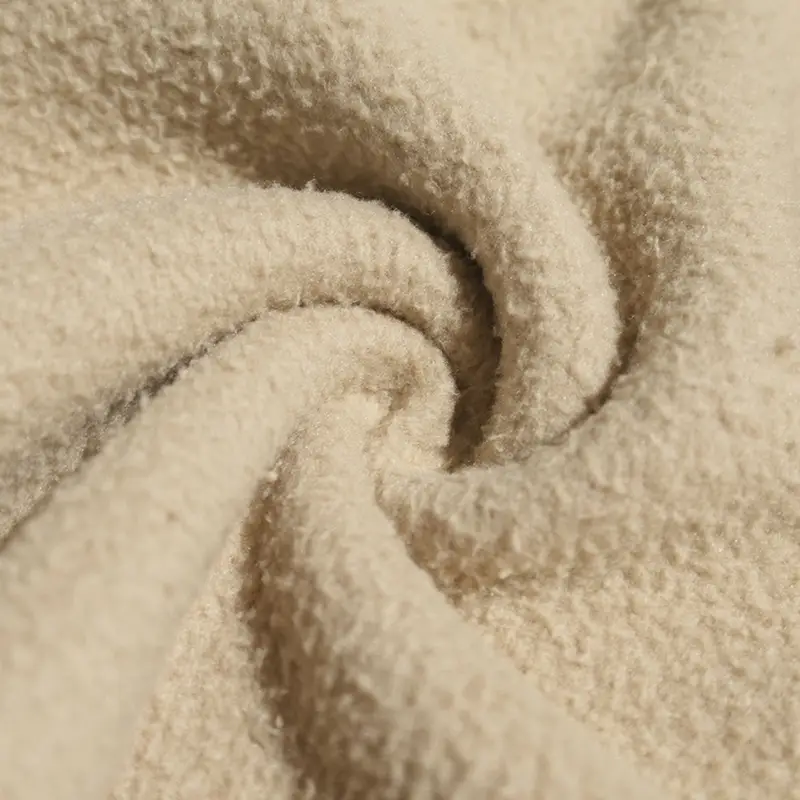
Two 400 GSM fabrics can behave differently. Fiber, yarn, stitch length, knit density, brushing, compacting, and finishing affect hand, recovery, dyeing, abrasion, and care.
- 100% cotton: supports a familiar streetwear hand and many garment-wash effects, but dimensional stability must be tested.
- Cotton-polyester blend: may improve stability or drying behavior depending on construction, while dye uptake and surface appearance can differ between fibers.
- Face cotton with a blended back: can preserve a cotton printing face while using the inside yarn for stability or loft; the exact plating arrangement should be documented.
- Added elastane: can support rib recovery, but percentage, placement, heat exposure, and wash durability need confirmation.
For U.S. sales, fiber-content claims are not optional marketing decoration. The FTC textile labeling guidance explains required disclosures such as fiber content, country of origin, and responsible business identity. Confirm the requirements for every destination market.
Fit, Hood Construction, and Rib Must Match the Weight
Heavy fabric does not create a good hoodie by itself. Evaluate body width, length, shoulder drop, armhole, sleeve volume, cuff, hood, pocket, and waistband as one system.
- A double-layer self-fabric hood adds substantial mass around the neckline.
- A lined hood may behave differently from a doubled main-fabric hood.
- Rib needs enough recovery and power to control the sleeve and body, not merely a matching color.
- Zip hoodies need zipper tape and length compatible with post-wash front-body measurements.
- Thick seam intersections may require construction changes, grading, or reduced bulk.

Use the custom hoodie manufacturing guide for the full development sequence and compare hoodie decisions with the custom sweatshirt sourcing guide when the collection includes matching crewnecks.
Specify Finished GSM and an Agreed Tolerance
“400 GSM cotton fleece” is incomplete. State whether 400 GSM is the finished target after dyeing, brushing, compacting, and any garment wash. Then identify the test method, conditioning, sampling location, number of specimens, and acceptance tolerance. The acceptable tolerance is a buyer-supplier decision based on product risk and process capability, not a universal value from this article.
These examples show how tolerance math works around a 400 GSM target:
| Illustrative tolerance | Calculated lower limit | Calculated upper limit | Total permitted band |
|---|---|---|---|
| +/- 3% | 388 GSM | 412 GSM | 24 GSM |
| +/- 5% | 380 GSM | 420 GSM | 40 GSM |
| +/- 7% | 372 GSM | 428 GSM | 56 GSM |
The table does not recommend one tolerance. It shows why a percentage must be converted into real limits before ordering. Also define whether results are averaged, whether every specimen must pass, and how outlying rolls will be handled.
Test Shrinkage After the Intended Wash and Dry Procedure
GSM and shrinkage interact. Washing can change both dimensions and fabric mass per area as the knit relaxes or compacts. Test the selected fabric and complete garment using the care route that supports the intended label.
Dimensional change (%) = (after-wash measurement – before-wash measurement) / before-wash measurement x 100
If a hoodie body length changes from 72.0 cm to 69.8 cm, the result is approximately -3.06%, meaning shrinkage in that measurement. Width, sleeves, hood, rib, pocket, and body length can move by different amounts, so one figure cannot describe the complete garment.
ISO 6330:2021 specifies domestic washing and drying procedures for textile testing. ISO 5077:2007 addresses determination of dimensional change after specified washing and drying. The AATCC standards directory also lists fabric and garment dimensional-change methods. Name the exact method, procedure, cycle count, and drying condition in the purchase order.
Decoration Can Change the Best GSM Choice
A dense fabric can support embroidery or structured graphics, but more weight is not always better. High stitch density can distort the chest if backing and tension are wrong. Thick seams can interfere with oversized screen placement. Puff print, silicone, heat transfer, appliqué, and embroidery each respond differently to stretch, heat, washing, and the fabric surface.
Approve decoration on the production fabric after all relevant finishing. Record artwork dimensions, placement from fixed measurement points, color references, backing, stitch count where applicable, curing or pressing conditions, and wash-test requirements. Dohyee’s custom apparel techniques page provides visual references for print and embellishment options.
What to Put in a Heavyweight Hoodie Tech Pack
- Finished GSM target, tolerance, test method, conditioning, and sampling plan.
- Fiber percentages, yarn information if controlled, knit construction, face and reverse description.
- Fabric width, usable width, color, dye route, brushing, compacting, and wash finish.
- Post-wash measurement chart with points of measure and tolerances by size.
- Hood layers, lining, drawcord, eyelets, pocket, zipper, rib composition, rib GSM, and recovery requirement.
- Seam type, stitch type, needle and thread requirements where performance depends on them.
- Artwork sequence, placement, size, color, and approval method.
- Care instructions, destination market, test plan, packaging, carton limits, and delivery date.
Use Dohyee’s custom apparel accessories reference when specifying drawcords, zippers, eyelets, labels, and packaging. The labels and packaging guide covers approval fields that are often missed in an early hoodie brief.
Sample and Inspect Before Bulk Production
- Swatch comparison: compare composition, finished GSM, construction, hand, face, reverse, stretch, and color.
- Fabric test: verify mass per area and relevant dimensional, colorfastness, pilling, and abrasion requirements.
- Prototype: review silhouette, hood balance, pocket, rib, seam bulk, and decoration.
- Wash test: measure the garment before and after the specified cycles and drying route.
- Size set: confirm grading and weight-related fit issues across critical sizes.
- Pre-production sample: combine production fabric, color, trims, artwork, wash, labels, and packaging.
- Bulk checks: sample more than one roll and production stage; compare results with the approved standard.
Record failed results, causes, corrective actions, and new approval versions. For factory evaluation, read the custom streetwear manufacturer guide.

FAQ About the Best GSM for Hoodies
Is 280 GSM good for a hoodie?
Yes, for easy layering, lower bulk, or warm-market wear. Confirm recovery, hood shape, rib balance, and retail hand through a finished sample.
Is 350 GSM considered heavyweight?
There is no universal cutoff. 350 GSM can feel substantial, but construction and brushing may make equal-weight fabrics feel denser, warmer, or loftier.
Is 400 GSM good for streetwear hoodies?
400 GSM is a useful starting point for structured, boxy, or cold-season hoodies. Pattern, hood, rib, seams, wash, and decoration still determine quality.
Is a 500 GSM hoodie always better?
No. It may add bulk, cost, and freight without improving fit. Use 500 GSM when substantial weight supports the concept and the sample proves wearability.
Does higher GSM mean warmer?
Not by itself. Warmth also depends on thickness, trapped air, brushing, fiber, knit density, fit, openings, lining, and layers.
What is the best GSM for an oversized hoodie?
330-450 GSM is a planning band, not a rule. Oversized patterns already add mass, so test shoulder balance, hood pull, sleeve volume, and rib recovery.
Should the tech pack state fabric GSM before or after washing?
State the finished approval condition. If pre-finish data is needed for process control, label it separately from the finished target.
How many GSM tests should a buyer request?
It depends on lot size, roll count, risk, method, and purchase agreement. Define sampling before production; one swatch cannot represent every roll.
Primary References
- Fabric mass: ASTM D3776/D3776M, Mass Per Unit Area (Weight) of Fabric.
- Unit conversion: NIST Guide to the SI, conversion factors.
- Wash procedures: ISO 6330:2021, domestic washing and drying procedures for textile testing.
- Dimensional change: ISO 5077:2007, determination of dimensional change in washing and drying.
- Test-method directory: AATCC standard test methods and procedures.
- U.S. labeling: FTC textile and wool labeling guidance.
Prepare a Comparable Hoodie Fabric Request
Ask each supplier to quote the same specification: style and fit, finished GSM and tolerance, fiber content, knit construction, face and reverse, color, brushing, washing, quantity by color and size, decoration, trims, post-wash measurements, testing, packaging, destination, and deadline. Request physical swatches and a complete sample before judging the best GSM for hoodies in your collection.
Dohyee’s OEM streetwear service page provides the wider development route. Submit the specification, reference images, target market, quantities, and required date through the Dohyee contact page for a feasibility review.